

Crystal Instruments EDM Modal Complete Modal Testing and Analysis Software Suite
A complete modal testing and analysis suite for EMA, supporting up to 512 input…
Complete identification toolset from FRF selection to mode shape animation, offering LSCE, PTD, Poly-X and SSI across Standard, Advanced and Premium tiers.
Made by Crystal Instruments Corporation. Supplied and supported in China by WTC (West Technology Corporation). · Manufacturer page ↗
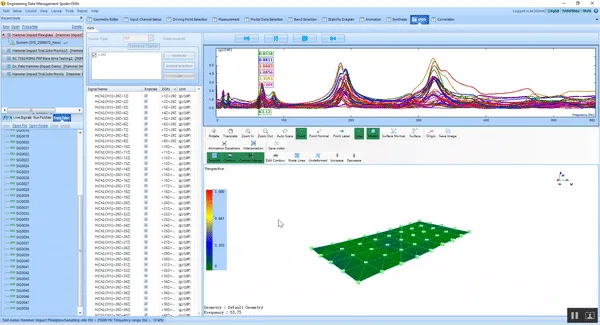
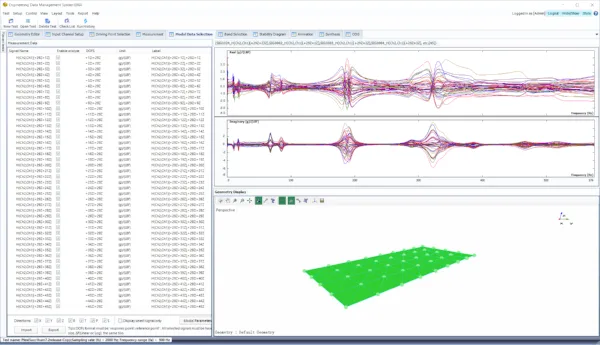
The Modal Analysis module picks up the FRF data produced by modal testing. Through Modal Data Selection, FRF signals are organized for rapid, comprehensive review, one by one or together in one graph, and can be exported or imported from other sources, with individual FRFs added or replaced. Identification starts with one click: Mode Indicator Functions (MIF, in Multivariate, Complex, Real and Imaginary Sum forms) help label natural frequencies and reveal repeated and closely spaced roots. A Stability Diagram combined with curve fitting then selects the physical poles, mode shapes are computed and stored in a shape table, and results are validated with the MAC function and FRF synthesis.
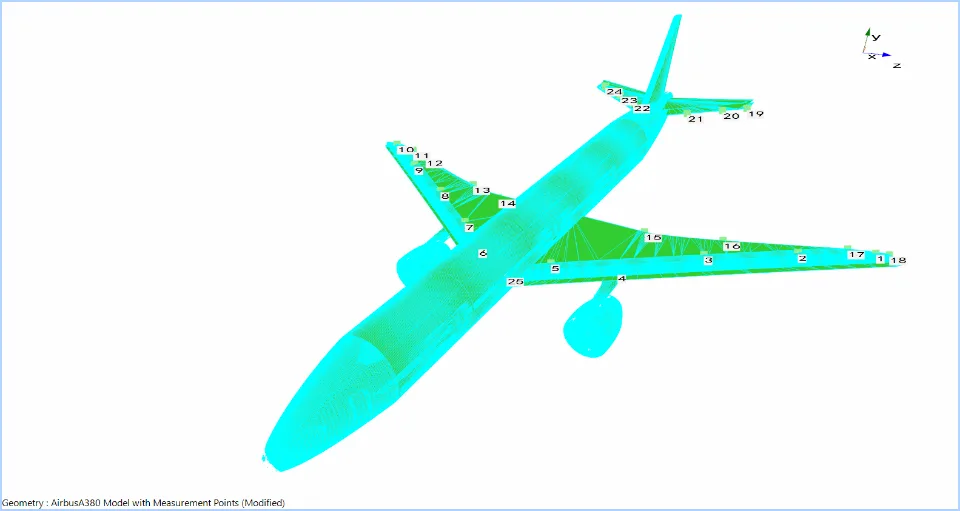
The tiers build on each other. Standard implements the proven Least-Square Complex Exponential (LSCE) fitter for pole identification and the Least-Square Frequency Domain (LSFD) algorithm for mode shapes, plus signal smoothing with deconvolution (for OMA), a user-selectable identification band, mode shape animation (wireframe, surface contour, FFD, interpolation, node lines, an animation equation editor for unmeasured DOFs) and synthesized-versus-measured FRF comparison with correlation and error values. Advanced adds the Poly-Reference Time Domain (PTD) method to curve-fit the FRF matrix from MIMO results on top of all Standard features; the fitter is selected automatically per single or multiple reference.
Premium adds Poly-X, the poly-reference Least-Square Complex Frequency Domain (p-LSCF) algorithm for MIMO FRF matrices, giving a neat stability diagram that emphasizes stable poles; time-domain, Poly-X or SSI methods can all be chosen for single- or poly-reference data sets. A dedicated Operational Modal curve fitter brings in Stochastic Subspace Identification (SSI), cleaner and more efficient for operational modal analysis on single- or multi-reference cross-power spectrum data.
This entry describes a solution or service without fixed hardware specifications. Contact us for a configuration.
Tell us the test object and the standard you must meet. An engineer replies within one business day.
A complete modal testing and analysis suite for EMA, supporting up to 512 input…
A single-operator hammer impact modal workflow with double-hit detection, drivi…
Multi-shaker synchronous excitation captures multiple FRF columns at once, with…
The primary EDM Modal module: build or import geometry and visualize mode shape…
Send us the test object, the standard and your lab conditions. You get a configuration list within one business day.