

Crystal Instruments Applications of Experimental Modal Analysis
A practical survey of Experimental Modal Analysis applications, from troublesho…
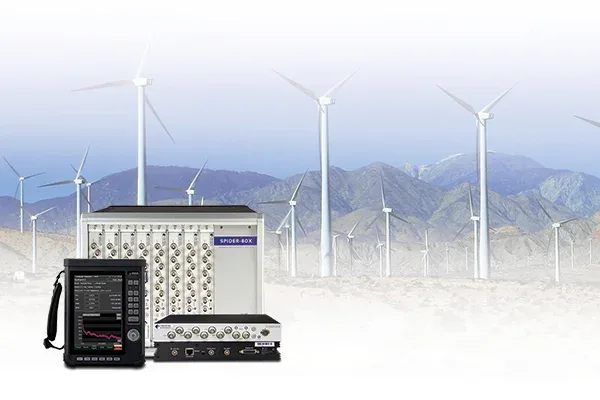
High-channel Spider-80X and handheld CoCo-80X capture force/response FRFs, describing thousands of DOFs with a few modes to validate finite element models
Made by Crystal Instruments Corporation. Supplied and supported in China by WTC (West Technology Corporation). · Manufacturer page ↗
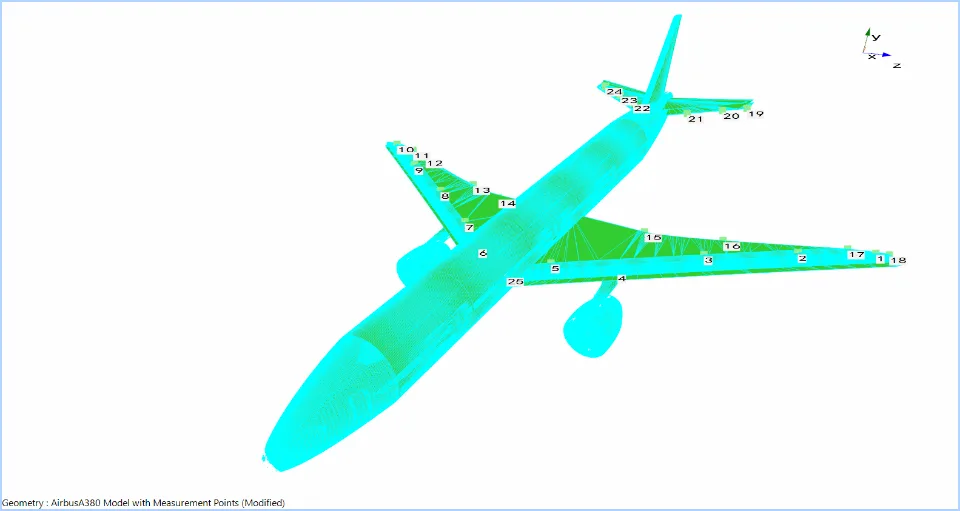
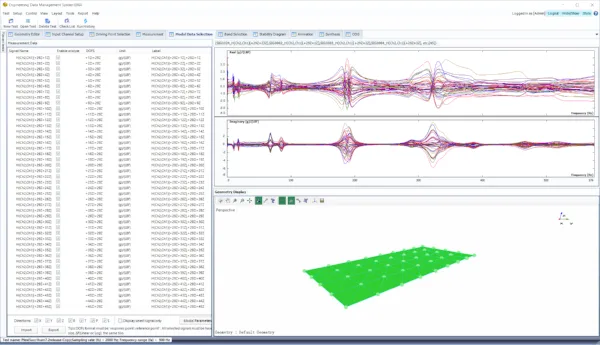
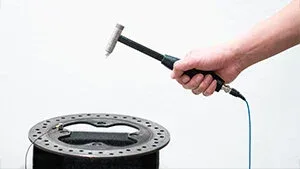
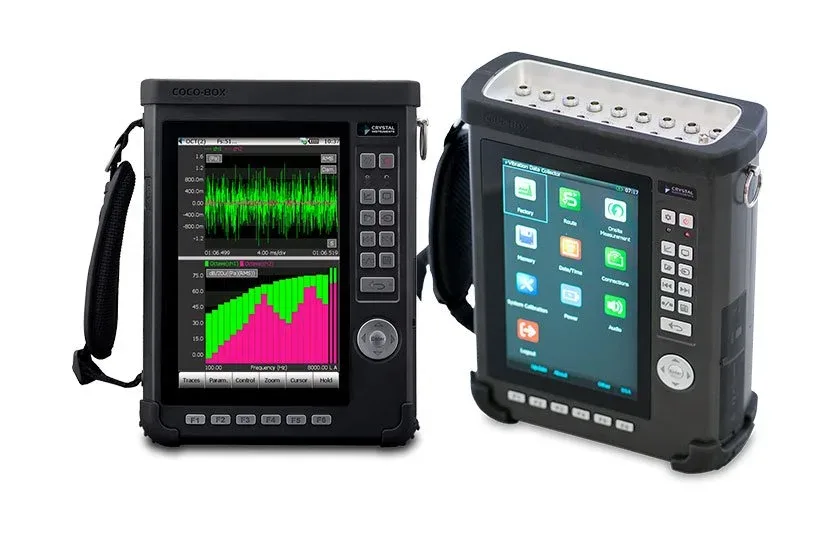
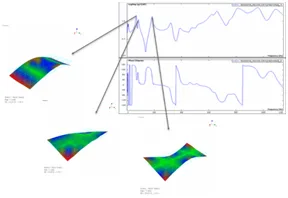
Structural dynamics testing solutions combine the high-channel Spider-80X with the handheld CoCo-80X to measure how a structure vibrates under applied force. Many structural problems are solved by identifying the natural frequencies at which the structure resonates and the percent critical damping of each resonance. Some are addressed by changing an operating RPM or shifting a resonance frequency through stiffening or mass-loading to avoid a frequency coincidence; others by applying a damping treatment to a structure that rings like a bell, adding isolation mounts to quiet floor vibration, or appending a tuned vibration absorber to split a resonance into two acceptably different frequencies. All of these fixes are aided by applying a measured force to the problem structure and measuring the ratio of its response acceleration to that force as a function of frequency. Once prototype or production hardware exists, laboratory or field tests can confirm or invalidate a finite element model (FEM). One of the most basic yet informative comparisons is the similarity between the experimental and analytic modes, each consisting of a resonance frequency, a damping factor, a modal mass and a mode shape. Modes are an important form of data reduction: any vibratory motion the structure can exhibit can be expressed as a linear combination of the mode shapes, so motion at thousands of locations and directions (degrees-of-freedom) can be described using only a small number of modes. Modal properties are identified from a series of acceleration/force Frequency Response Functions. An electrodynamic shaker excites the structure at one DOF while an accelerometer measures the response at the same or a second DOF. The full FRF set may be acquired with a single roving accelerometer and a 2-channel DSA, or more efficiently with multiple accelerometers measured simultaneously by a high-channel DSA. A force-instrumented impact hammer with a single accelerometer forms a compact field kit for the CoCo; exploiting structural reciprocity, most users mount the accelerometer at a fixed DOF and rove the impact DOF. The CoCo-80X adds patented GPS time synchronization with 100 ns accuracy for operational modal analysis of large bridges and buildings. Capabilities span roving impact or roving response hammer testing, random, burst random or chirp shaker testing, resonance frequency and damping identification, real or complex mode shapes, verification of linear independence of mode shapes and FEM validation/updating.
This entry describes a solution or service without fixed hardware specifications. Contact us for a configuration.
Tell us the test object and the standard you must meet. An engineer replies within one business day.
A practical survey of Experimental Modal Analysis applications, from troublesho…
A complete modal testing and analysis suite for EMA, supporting up to 512 input…
Complete identification toolset from FRF selection to mode shape animation, off…
A single-operator hammer impact modal workflow with double-hit detection, drivi…
Send us the test object, the standard and your lab conditions. You get a configuration list within one business day.