

Crystal Instruments EDM Modal Complete Modal Testing and Analysis Software Suite
A complete modal testing and analysis suite for EMA, supporting up to 512 input…
Identifies modes from ambient vibration response alone, with no controlled excitation needed for large structures such as bridges and offshore platforms
Made by Crystal Instruments Corporation. Supplied and supported in China by WTC (West Technology Corporation). · Manufacturer page ↗
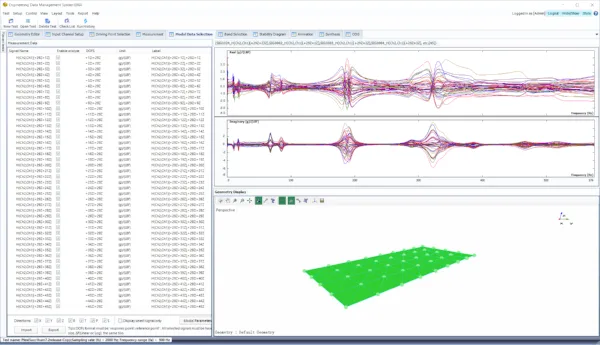
Operational Modal Analysis (OMA) is a dedicated module within the EDM Modal suite that is built around ambient vibration data, with its own test setup and operating process flow. Used together with a large channel-count acquisition system such as the Spider-80X or Spider-80Xi, this excitation method delivers higher efficiency and accuracy for the measurements while minimizing local stresses on the test article. Conventional modal analysis methods and procedures are based on forced excitation tests carried out in the laboratory, where Frequency Response Functions (FRFs) are measured as input to modal parameter identification. However, the real loading conditions a structure experiences often differ considerably from those reproduced in a laboratory test. In many cases such as the excitation of offshore platforms or the traffic and wind excitation of a bridge, forced excitation tests are very difficult, if not impossible, to conduct with standard testing equipment. Operational vibration data is then often the only resource available. Operational modal testing is designed to measure and process this ambient vibration response data so that it is ready for parameter identification, and the resulting cross power spectrum vectors can be further smoothed with a de-convolution method. Software features include an ease-of-use testing process, point/direction auto or manual increment, a user-defined reference channel, a Scope tab to view channel data before measuring, an expanded cross power spectrum for every input channel versus the reference channel, and cross power spectrum vector smoothing that can be applied multiple times or cancelled. The modal analysis process is seamlessly integrated with operational modal testing, so measured data flows directly into identification.
This entry describes a solution or service without fixed hardware specifications. Contact us for a configuration.
Tell us the test object and the standard you must meet. An engineer replies within one business day.
A complete modal testing and analysis suite for EMA, supporting up to 512 input…
Complete identification toolset from FRF selection to mode shape animation, off…
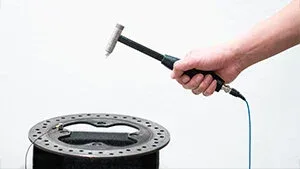
A single-operator hammer impact modal workflow with double-hit detection, drivi…
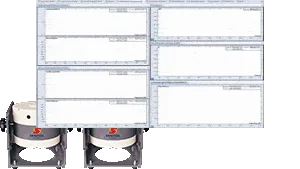
Multi-shaker synchronous excitation captures multiple FRF columns at once, with…
Send us the test object, the standard and your lab conditions. You get a configuration list within one business day.