
Crystal Instruments North Carolina Vibration Testing Lab
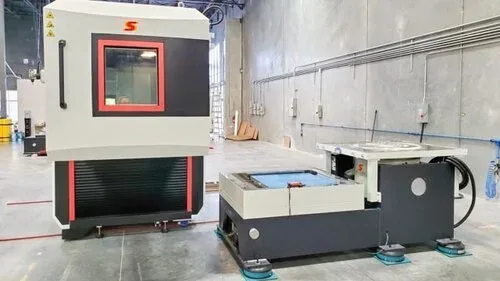
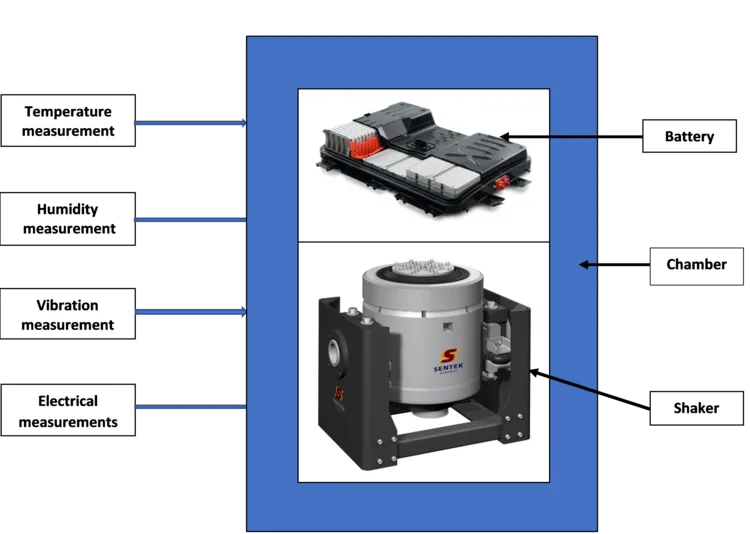
Single-axis, three-axis MIMO and MESA shakers plus a THV combined chamber, with…
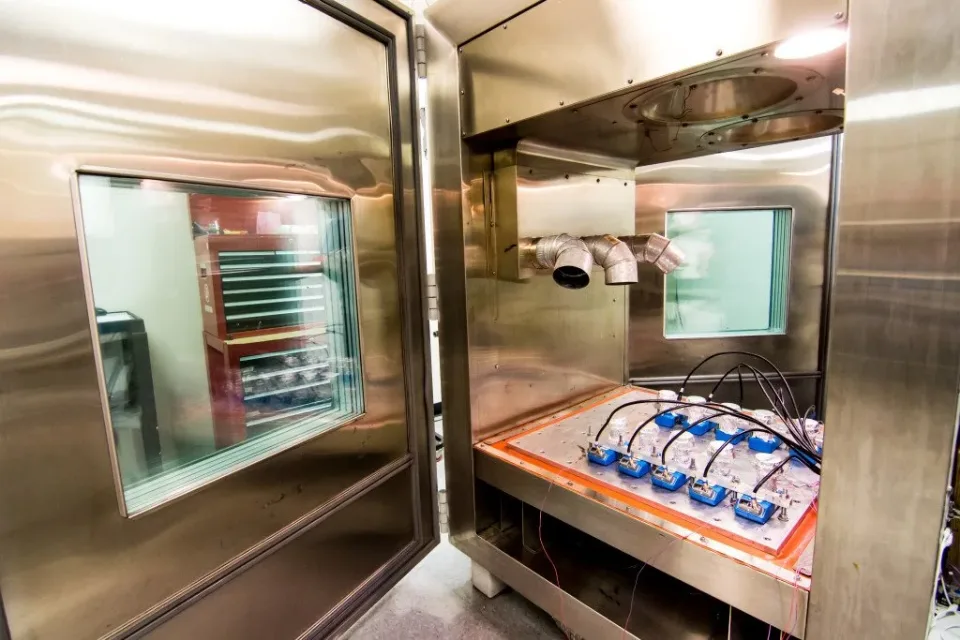
From -100 to +200 C, faster than 50 C/min transitions and up to 60 gRMS six-DOF repetitive shock locate design and manufacturing weaknesses in hours.
This page describes a Crystal Instruments laboratory. WTC helps customers in China arrange contract testing and interpret reports.
Made by Crystal Instruments Corporation. Supplied and supported in China by WTC (West Technology Corporation). · Manufacturer page ↗
HALT, or Highly Accelerated Life Testing, is a high-stress test used to discover weaknesses early in a product's lifecycle, typically while the product is still in its design or development stage. Traditional tests can need days or even months for partial results, whereas HALT raises temperature and vibration stress step by step over short intervals to exceed expected use parameters and hasten failure within hours. Because it is designed to uncover faults and anomalies, HALT should not be treated as a pass/fail test; it reveals the weakest areas of a design. Repeating HALT periodically during development lets designers make improvements before production begins.
The standard HALT procedure has five steps: hot thermal step stress, cold thermal step stress, rapid thermal cycling, vibration step stress, and a combined environment. Compared with traditional methods such as Design Verification Testing and Environmental Stress Screening, HALT significantly shortens the time required to find likely failures.
HASS, or Highly Accelerated Stress Screening, is aimed at defects and weaknesses introduced by production and manufacturing processes and is usually run on products that have already passed HALT and entered production. Both are forms of Accelerated Stress Testing, but HASS applies incremental stresses that exceed the product's specifications while remaining within the design limits established by the earlier HALT results. The combination of thermal and vibration stress finds defects that would otherwise appear as out-of-box failures, saving the manufacturer warranty cost and customer confidence; timely HASS results let reliability engineers correct a product before shipment.
On the equipment side, the HALT and HASS chambers provide real-time reporting across -100 C to +200 C with transition rates above 50 C/min and up to 60 gRMS six-DOF repetitive shock, with programmable SSRs for UUT automation. Six response accelerometers and eighteen auxiliary thermocouples are standard. The lab also offers in-house fixture design and fabrication, from small fixtures up to fully automated test sleds including software, with HALT and HASS fixture design as a core specialty.
This entry describes a solution or service without fixed hardware specifications. Contact us for a configuration.
Tell us the test object and the standard you must meet. An engineer replies within one business day.
Single-axis, three-axis MIMO and MESA shakers plus a THV combined chamber, with…
The Los Angeles lab is equipped with two OVS HALT chambers, a Sentek M6044A sha…
A 98 kN water-cooled shaker with a 1200 x 1200 mm slip table, plus -70 to 150 C…
MIL-STD-810 and MIL-STD-202 testing services covering temperature, humidity, sh…
Send us the test object, the standard and your lab conditions. You get a configuration list within one business day.