

Crystal Instruments Military Standard (MIL-STD) Environmental Testing Service
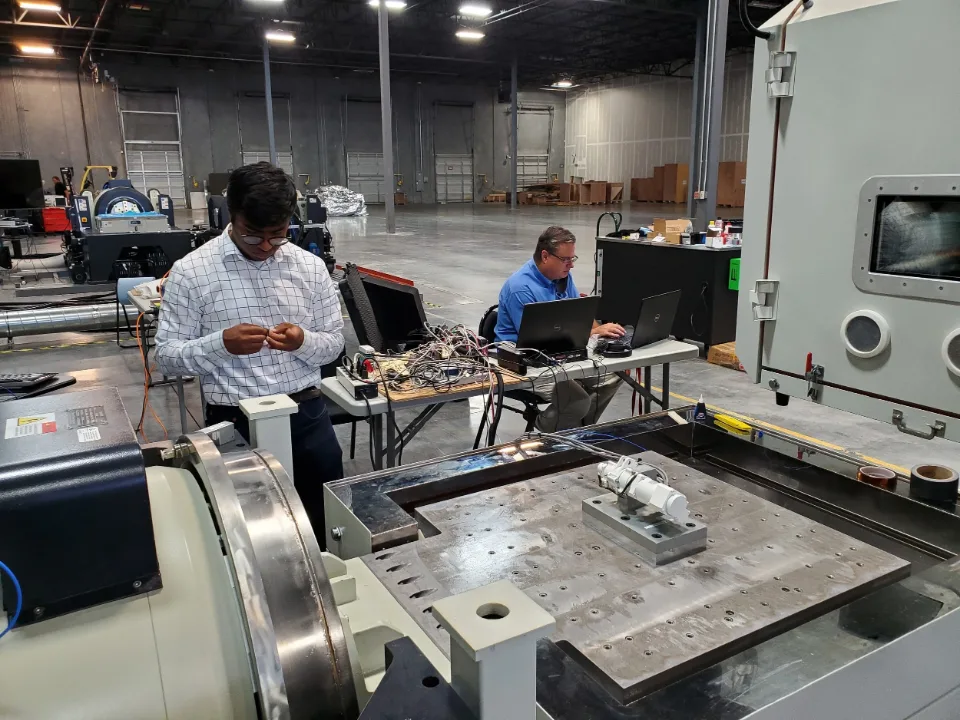
MIL-STD-810 and MIL-STD-202 testing services covering temperature, humidity, sh…
Measuring frequency response functions to identify modal frequencies, damping and mode shapes, from silicon wafers to large industrial structures.
Made by Crystal Instruments Corporation. Supplied and supported in China by WTC (West Technology Corporation). · Manufacturer page ↗
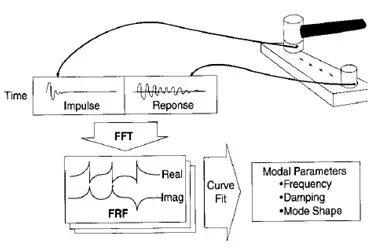
Modal testing is a common method of characterizing the vibrations of a structure by imparting a known force and measuring the response. Measuring both input and response yields the structure's frequency response function (FRF). Calculating the FRF at multiple locations produces data that estimates the dynamic response of the structure and identifies its modal frequencies, damping and mode shapes. At those modal frequencies the structure vibrates with minimal input energy, so exciting it there can easily cause damage; characterizing the response lets engineers change the design to reduce it or adjust operating conditions to avoid failures.
The scale of a modal test varies greatly, from silicon wafers used in electronics to multistory industrial sifters at rock quarries. Size and geometry determine how the structure is excited, and the two most common methods are impact testing with a modal hammer and shaker testing. An impact test uses an impact modal hammer and a response accelerometer; the hammer imparts an impulse intended to excite a broad bandwidth, and its size, sensitivity and hardness depend on the structure scale and bandwidth of interest, while the accelerometer must detect ringing without saturating. It is usually easier to mount the accelerometer in one location and vary the impact location, a roving impact test; impact locations must be carefully planned and documented so individual FRFs can be pieced together.
After collection, data can be processed with software such as Vibrant Technology's ME'scope to produce an animated model of operating deflection shapes (ODS). Crystal Instruments CoCo-80 or CoCo-90 dynamic signal analyzers connect directly to IEPE impact hammers and accelerometers without extra signal conditioning to extract resonance frequencies and damping. Correct trigger setup with pre-trigger captures the full transient, and the Force-Exponential window leaves the impact and initial response untouched while forcing tail ringing to zero, minimizing erroneous high-frequency content in the FRF.
Tell us the test object and the standard you must meet. An engineer replies within one business day.
MIL-STD-810 and MIL-STD-202 testing services covering temperature, humidity, sh…
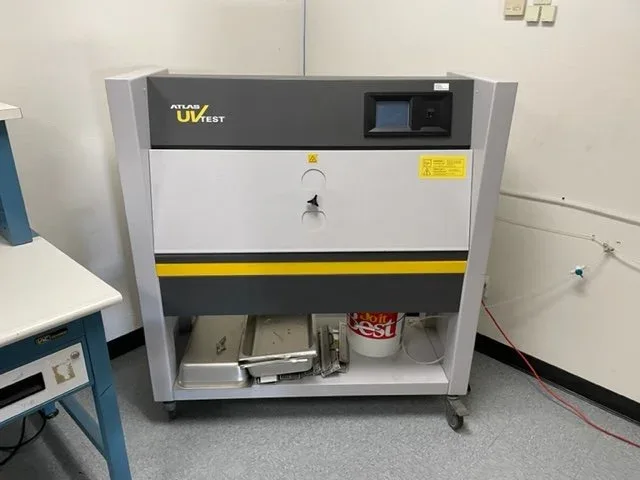
Fluorescent UV lamps (UVA 340, UVB 313, UVA 351) with condensation and spray re…
Custom-fabricated vibration test fixtures for electronics and circuit card asse…
Fatigue, push-pull-press and open-close testing combine vibration, shock and st…
Send us the test object, the standard and your lab conditions. You get a configuration list within one business day.