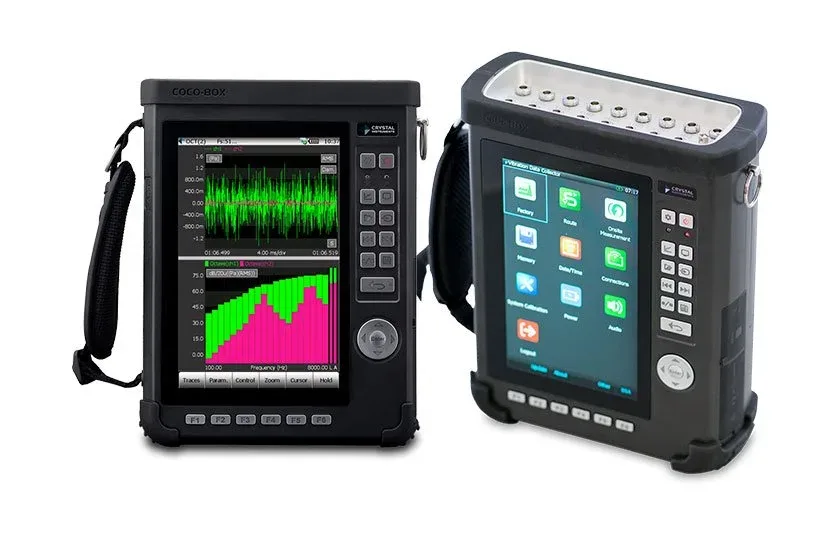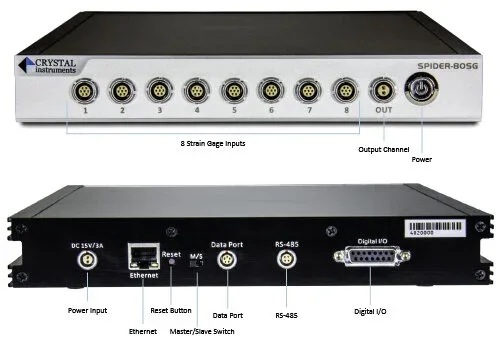

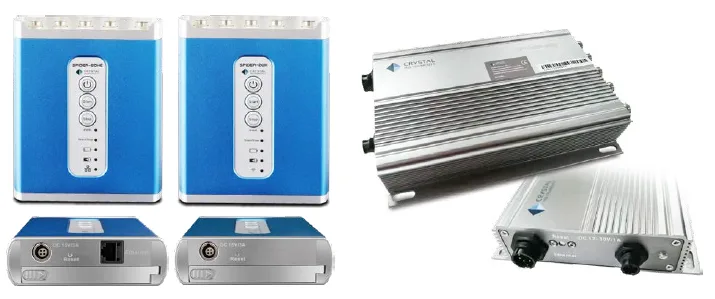
Crystal Instruments Spider-20 Dynamic Signal Analyzer & Data Recorder
- Input channels
- 4
- Coupling
- AC、DC、IEPE (ICP)
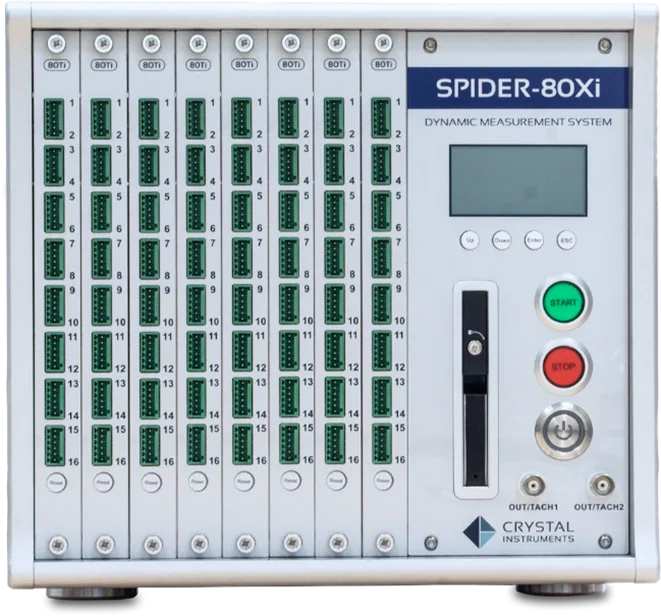

16 channels of 24-bit temperature measurement per front-end supporting PT100 RTD and K-type thermocouple, scalable to 1024 synchronized channels.
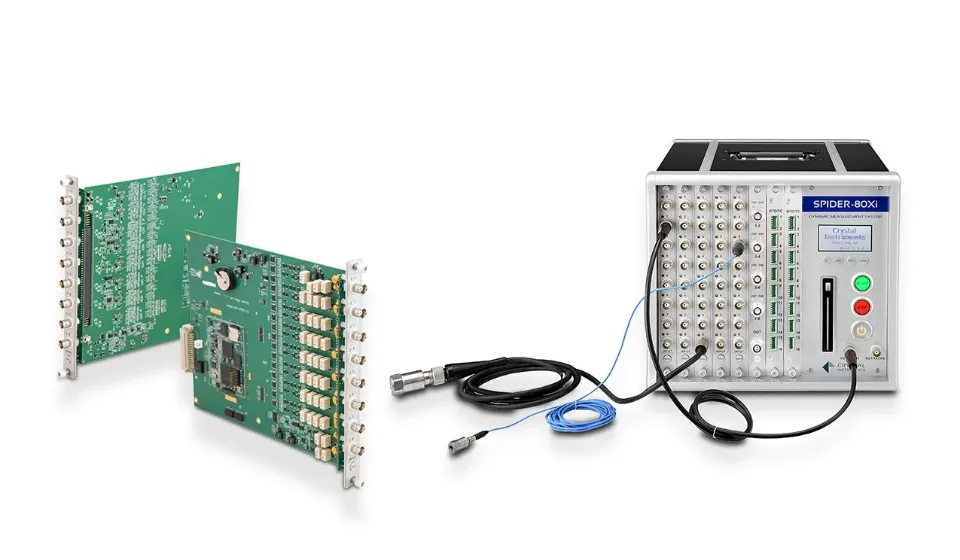
Manufacturer pageThe Spider-80Ti is the temperature measurement front-end of the Spider-80Xi hardware platform, bringing temperature signals into a unified dynamic measurement system. It supports the two most widely used industrial temperature sensors, thermocouples and RTDs (resistance temperature detectors), and each front-end adds 16 temperature channels to the system. A unit is user-configurable for either a PT100 RTD or a K-type thermocouple, and combining RTD-configured and thermocouple-configured modules lets a single Spider system mix both sensor types. Every channel uses a 24-bit sigma-delta ADC together with user-configurable non-linearity correction to ensure accuracy across a wide temperature range. RTD measurement uses a 3-wire scheme to cancel lead error: two wires link the element to the front-end on one side and one on the other, and the lead resistance is measured and subtracted from the total to obtain an accurate temperature. RTD channels span 0 to 400 ohm with a measurement range of -200 to 850 degrees Celsius and a programmable excitation current of 10 uA to 1.5 mA, and implement the IEC 751 RTD equations directly so users can apply standard or custom coefficients for RTDs of different alpha values. For thermocouples the front-end performs cold junction compensation using an isothermal block and a high-precision internal temperature sensor; with a K-type thermocouple the range is -270 to 1250 degrees Celsius with a +/-80 mV voltage range and cold junction compensation accuracy of +/-0.25 degree from 0 to 70 degrees Celsius. Both modes offer 115 dB CMRR and 105 dB normal-mode rejection, selectable sampling from 0.3125 to 512 samples per second, a 1 to 64 point moving linear average, and per-channel gain, offset and multi-point sensor correction. The Spider-80Xi chassis comes with 4 or 8 slots and can be filled entirely with temperature cards or mixed with Spider-80Hi, 80Ci and 80SGi cards; multiple chassis chain to up to 1024 simultaneously sampled channels with a removable 2.5-inch SSD storing NTFS data.
This entry describes a solution or service without fixed hardware specifications. Contact us for a configuration.
| Model | Input channels | Sample rate | ADC resolution | Dynamic range |
|---|---|---|---|---|
| Spider-80TiCurrent | — | — | — | — |
| Spider-20 | 4 | — | — | — |
| Spider-30R | — | — | — | — |
| Spider-80SG | — | — | — | — |
| Spider-80Xi / 80Hi | 8 (Spider-80Hi / 80Ci) | — | — | 175 dBFS |
| Spider-HUB | — | — | — | — |
Scroll sideways for all columns
Change the sampling rate and see how sample points describe a sine wave.
Mathematical illustration: a 5 Hz sine input. Not measured equipment data or a product performance claim. Actual selection also depends on bandwidth and anti-alias filtering.
Explore signal analyzers40 Hz sampling: approximately 8 samples per cycle.
Tell us the test object and the standard you must meet. An engineer replies within one business day.