
Crystal Instruments CoCo Handheld Data Acquisition System
Battery-powered handheld DAQ with 2/4/8/16 channels, 8-channel simultaneous rec…
 Series overview
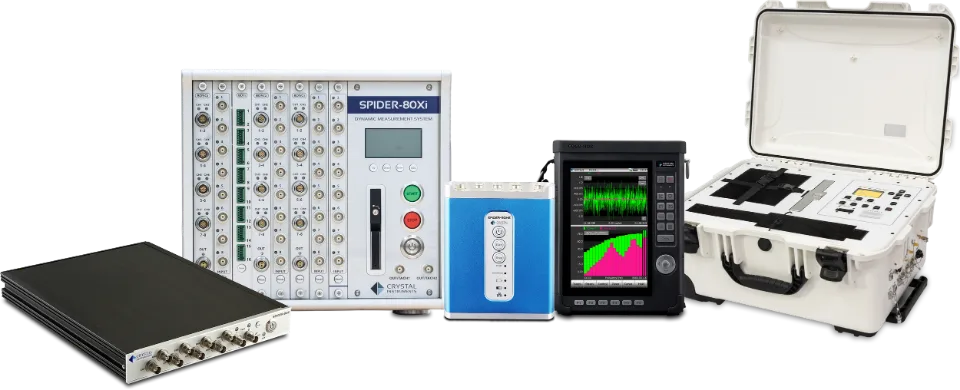
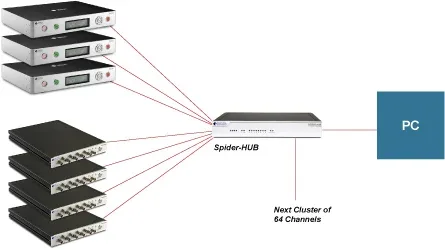
Build a large-scale synchronized dynamic measurement system by clustering multiple Spider-80X/Spider-81 front-ends over a Spider-HUB.
Manufacturer pageA high channel count dynamic measurement system is not a single instrument but a distributed acquisition architecture built around Crystal Instruments Spider front-ends. The building block is a Spider-80X or Spider-81 front-end, each carrying its own DSP, local storage and Ethernet interface. Clustering several front-ends through a Spider-HUB industrial Ethernet switch and connecting the cluster to a host PC creates one high channel count system. Expansion is straightforward: the Spider-HUB exposes ten Ethernet ports, one for the PC, the rest for Spider front-ends, with a spare port that can be wired to the next cluster so channel count grows cluster by cluster without replacing the host. Mixed module types can coexist in a single system; for example, a Spider-80Xi chassis holding Spider-80SGi strain cards and Spider-80Ti temperature cards can be combined with four Spider-80X front-ends to acquire vibration, strain and temperature simultaneously. Because every front-end stores data locally at full speed before transfer, recording is not limited by network throughput, and a Spider-NAS can serve as centralized high-speed storage that captures all dynamic channels at 256 kHz. Federated by Crystal Instruments EDM software and IEEE 1588 precision time protocol, front-ends across clusters stay phase-aligned to better than 1 degree, making the configuration well suited to modal surveys of large structures and multi-point vibration testing of complete vehicles and machines.
| Model | Input channels | Sample rate | ADC resolution | Dynamic range | Input range | Weight |
|---|---|---|---|---|---|---|
| CoCo-70X | — | — | — | 150 dBFS | ±20 V | — |
| CoCo-80X / 90X | — | — | — | 150 dBFS (100 Hz–20 kHz) | ±20 Vpk | — |
| GRS (Ground Recorder System) | 4 | — | — | — | — | — |
| Luma-600 | — | — | — | — | — | — |
| Ruby | — | 16 kHz | — | — | — | — |
| Spider-20 | 4 | — | — | — | ±20 V、±2 V、±0.2 V | 0.56 kg (HE);0.52 kg (i) |
| Spider-30R | — | — | — | — | — | 0.65 lb |
| Spider-80SG | — | — | — | — | ±5 mV、±10 mV、±50 mV、±100 mV、±10 V | — |
| Spider-80Ti | — | — | — | — | — | — |
| Spider-80Xi / 80Hi | 8 (Spider-80Hi / 80Ci) | — | — | 175 dBFS | ±20 Vpk | — |
| Spider-HUB | — | — | — | — | — | 1.28 kg |
| Spider-NAS | — | — | — | — | — | 1.30 kg |
Scroll sideways for all columns
Change the sampling rate and see how sample points describe a sine wave.
Mathematical illustration: a 5 Hz sine input. Not measured equipment data or a product performance claim. Actual selection also depends on bandwidth and anti-alias filtering.
Explore signal analyzers40 Hz sampling: approximately 8 samples per cycle.
Tell us the test object and the standard you must meet. An engineer replies within one business day.
Battery-powered handheld DAQ with 2/4/8/16 channels, 8-channel simultaneous rec…
A complete dynamic measurement function set: 102.4 kHz time recording, FRF, aco…