

Crystal Instruments Vibration Diagnostics System (VDS)
Vibration data management and automated diagnostics for predictive maintenance…
Eight analog inputs plus two tachometer channels per front-end, 160 dBFS dynamic range, scalable to 128 channels via HUB/NAS, with EDM Cloud for remote monitoring across any distance.
Made by Crystal Instruments Corporation. Supplied and supported in China by WTC (West Technology Corporation). · Manufacturer page ↗
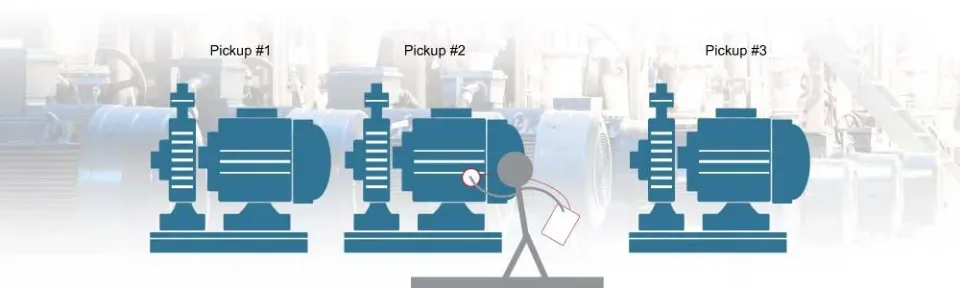
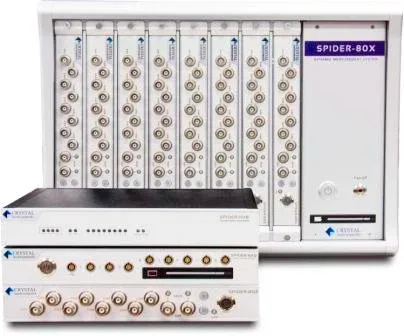
The compact Spider-80X is purpose-built for machine condition monitoring. Each front-end provides eight analog input channels plus two channels that can be software-selected as tachometer inputs for rotating-machinery analysis. Inputs offer absolute or differential configuration and AC/DC/IEPE coupling choices, with charge mode available as an option. Like every Crystal Instruments Spider product, the Spider-80X carries IEEE 1588 time-sync Ethernet connectivity and 4 GB of internal flash memory for data and program storage. Multiple front-ends can be linked through the eight-into-one Spider-HUB module, and storage can be expanded to 250 GB by adding a Spider-NAS mass-storage module, letting a single system reach up to 128 channels.
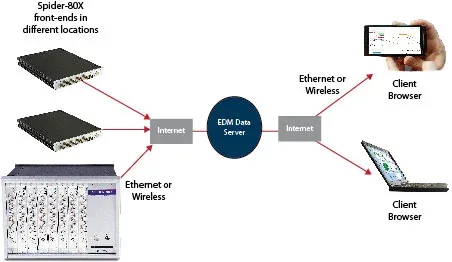
For remote work, the Spider-80X combines naturally with EDM Cloud, where the test engineer and the test can literally be oceans apart. Any of the usual EDM tests can be developed in the office, sent to far-away Spider front-ends, run locally on the hardware, checked against a variety of criteria, and viewed anywhere in the world in real time. EDM Cloud is server-based software for taking vibration and other measurements remotely through Spider front-ends; applications include machine condition monitoring, wind turbine vibration and status monitoring, bridge and railway vibration monitoring, and tunnel sound monitoring. Opening a browser on a tablet, iPad, PC or smartphone gives instant access to real-time or historical data.
Hardware specifications include eight BNC inputs per front-end with 24-bit A/D converters and a 160 dBFS dynamic range, a ±20 V range, and up to 102.4 kHz sampling per channel. Outputs are two BNC connectors per front-end at ±10 V with 100 dB dynamic range. Channel phase match is better than ±1.0 degree up to 20 kHz. At 238.8 x 215.7 x 20 mm and 1.3 kg per front-end, four units fit into one 1U 19-inch rack slot; power comes from an external DC source, and a 100Base-T RJ45 connector links to a PC or network switch. Real-time functions include recording, math, integration, differentiation, FFT, averaging, windowing, auto and cross spectra, FRF, coherence, real-time filters, RMS, swept sine, limiting and alarm/abort. The system runs connected to a computer or standalone in Black Box mode.
| Dynamic range | 160 dBFS |
|---|---|
| Input range | ±20 V |
Full datasheet on request.
| Model | Input channels | Sample rate | Dynamic range | Demod bandwidth |
|---|---|---|---|---|
| Spider-80X MCMCurrent | — | — | 160 dBFS | — |
| VDS | — | — | — | — |
Scroll sideways for all columns
Tell us the test object and the standard you must meet. An engineer replies within one business day.
Vibration data management and automated diagnostics for predictive maintenance…
Route-based vibration collection with the CoCo handheld analyzer and EDM softwa…
Replace bulky, fragile PC-based systems with Ethernet-integrated CoCo or modula…
Run-up and coast-down waterfalls with order tracking reveal transient instabili…
Send us the test object, the standard and your lab conditions. You get a configuration list within one business day.