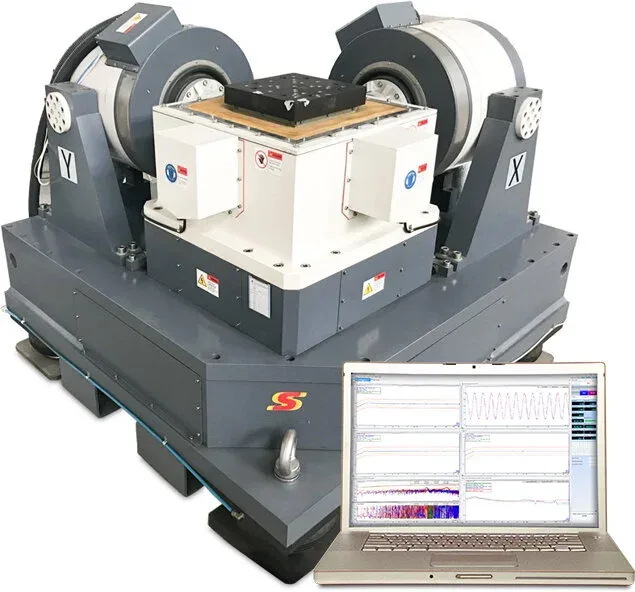

Crystal Instruments MIMO Shaker Systems
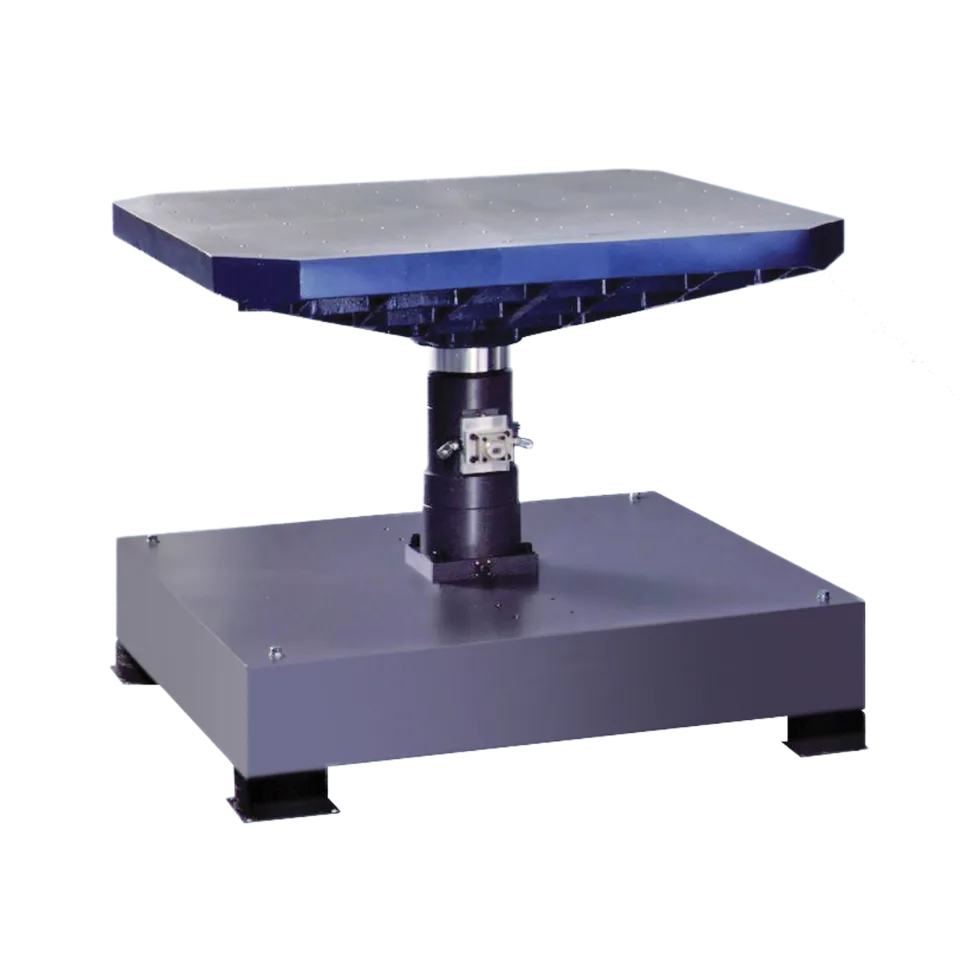
From MESA single-axis multi-exciter arrangements to 6-DOF eight-shaker tables…
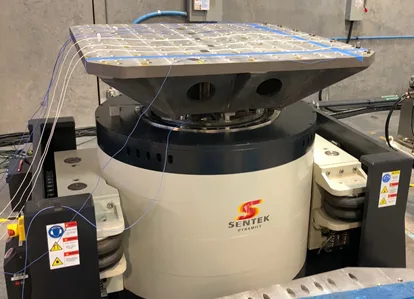
 Series overview
Closed-loop random, sine and shock vibration testing that drives electrodynamic, hydraulic or electric shakers alike.
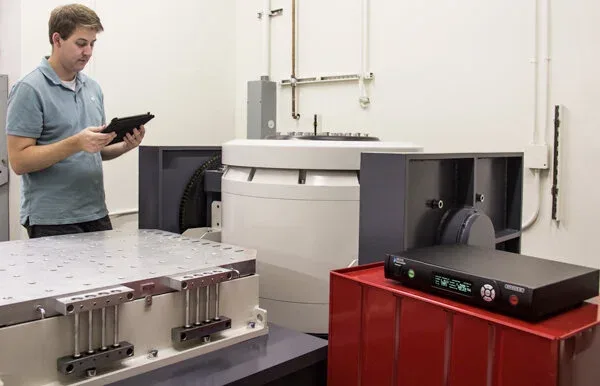
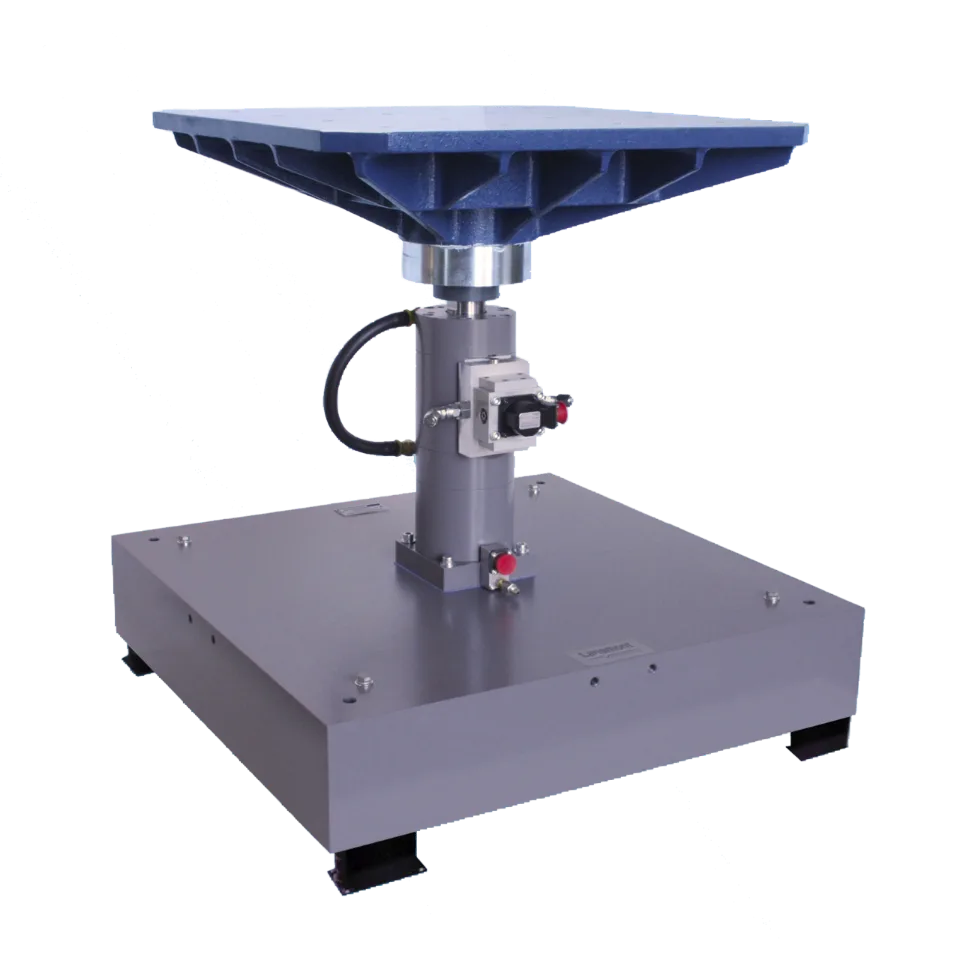
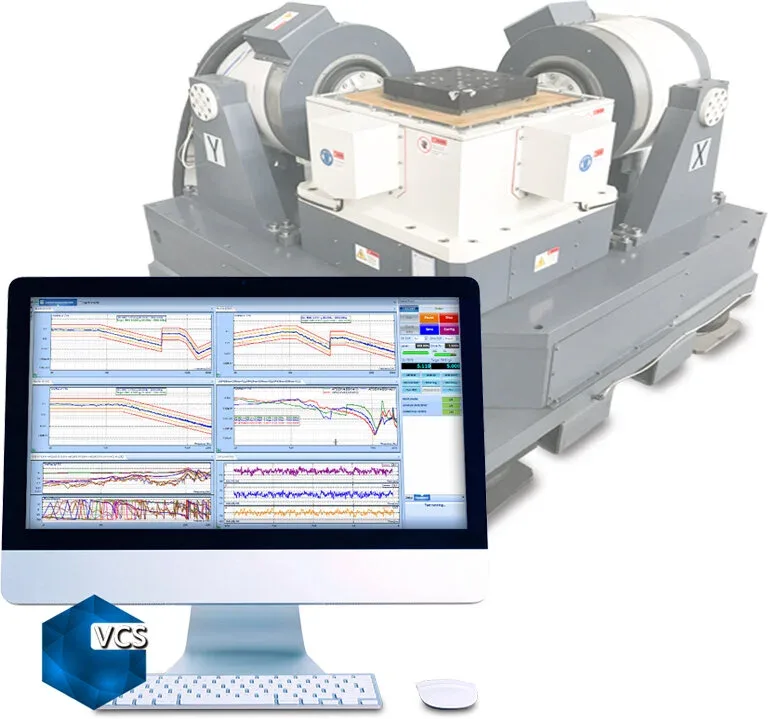
Manufacturer pageVibration and shock testing is environmental testing in which the unit under test is rigidly mounted on a shaker and subjected to controlled motion that mimics field conditions. A complete system has four parts: the shaker, a power amplifier, the vibration controller and the accelerometer. The controller loads the test specification and emits a low-voltage drive signal; the amplifier scales it to high power; the shaker excites the test object and the accelerometer, which returns measured acceleration to the controller as closed-loop feedback. The controller then adjusts the drive so the measured spectrum keeps tracking the target.
Three test classes dominate. Random testing excites all frequencies across a band (for example 5 Hz to 2000 Hz) to a target PSD defined by a breakpoint table; field-recorded data can be converted into a damage-equivalent profile using fatigue damage theory. Sine testing excites one frequency at a time with a pure sine drive, dwelling or sweeping logarithmically or linearly, with the spectrum accumulated over the sweep. Shock testing is defined in the time domain over a pulse of one second or less and is characterized by a Shock Response Spectrum — the peak response of a single-degree-of-freedom system plotted against its natural frequency; pulses may be mathematical (half-sine) or synthesized to match a target.
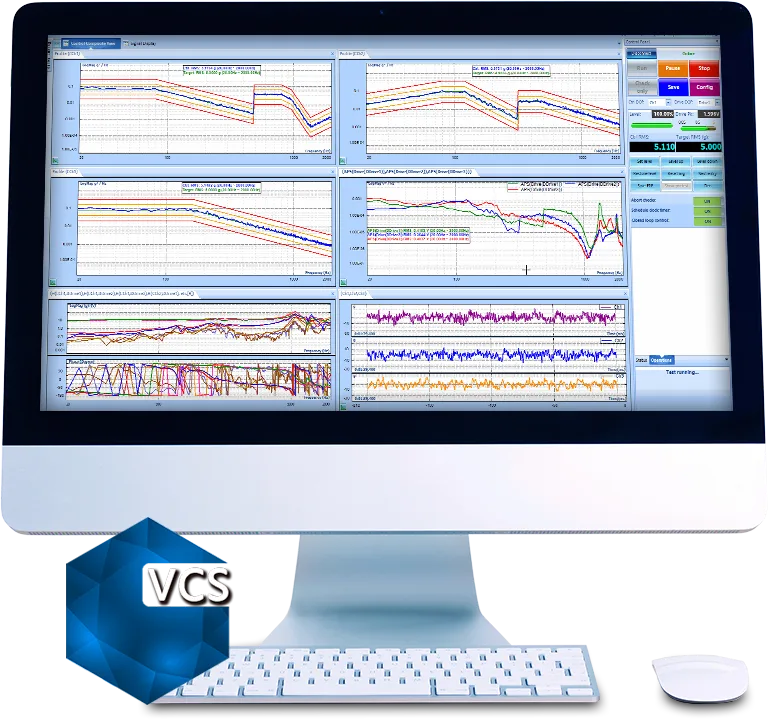
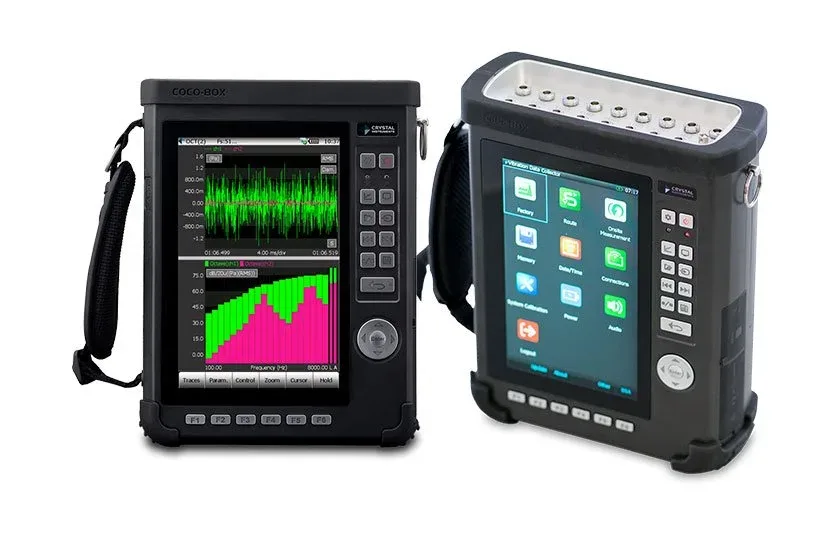
Crystal Instruments Spider controllers drive large and small electrodynamic, hydraulic and electrically driven shakers. Platforms include the expandable Spider-81 (8 inputs, 4 outputs), the basic Spider-81B (8 inputs, 1 output), the combined temperature/humidity/vibration Spider-101i (8 inputs, 2 outputs) and the VCS/DSA Spider-80X. Software covers sine, random, classical shock and transient control; Time Waveform Replication and Kurtosis control; Sine-on-Random and Random-on-Random modes; SRS analysis and synthesis; shock/drop and HALT/HASS, with full alarm, limit and notching protection. Markets include automotive, aerospace, avionics, telecom, consumer electronics and military equipment.
| Model | Input channels | Dynamic range | DAC resolution | Storage |
|---|---|---|---|---|
| Spider-80M | 16 / 24 / 32 / 48 / 56 | 160 dBFS | 24 bit | — |
| Spider-81 / 81B | — | 160 dBFS | 24 bit | 4 GB flash |
| Spider-101i | — | — | — | — |
Scroll sideways for all columns
Change the sampling rate and see how sample points describe a sine wave.
Mathematical illustration: a 5 Hz sine input. Not measured equipment data or a product performance claim. Actual selection also depends on bandwidth and anti-alias filtering.
Explore signal analyzers40 Hz sampling: approximately 8 samples per cycle.
Tell us the test object and the standard you must meet. An engineer replies within one business day.
From MESA single-axis multi-exciter arrangements to 6-DOF eight-shaker tables…
Full random, sine and shock control for single-axis shakers, with up to 100 dB…
Modular multiple-axis vibration testing that scales to 512 channels, covering t…
One controller synchronizing multiple exciters across six MIMO control types: R…