
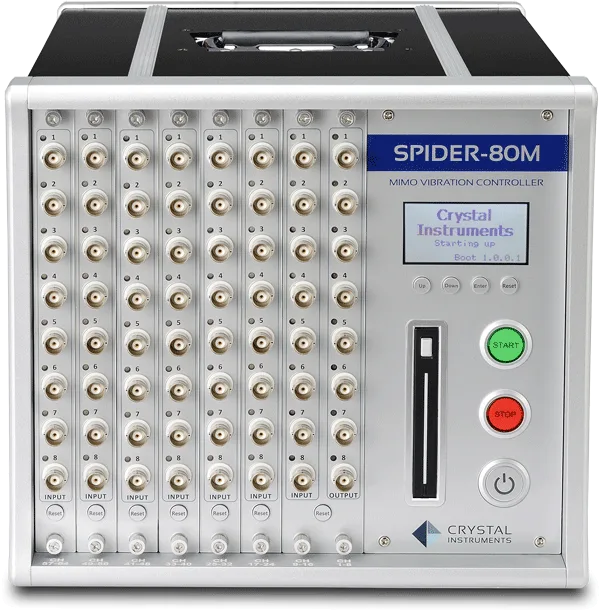
Crystal Instruments Spider-80M MIMO Vibration Test Controller
- Input channels
- 16 / 24 / 32 / 48 / 56
- DAC resolution
- 24 bit
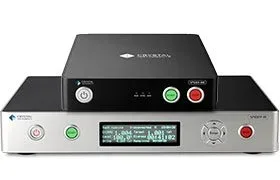

Embedded DSP runs control locally, 8 inputs scale to 512 channels, 160 dBFS input dynamic range, with standalone Black Box operation.
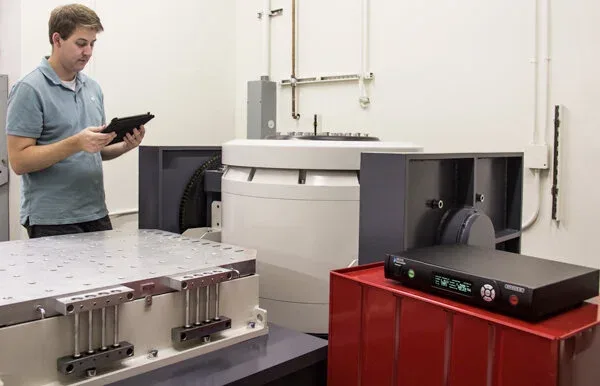
Manufacturer pageThe Spider-81 is a vibration test controller built on a DSP-centralized architecture. Traditional controllers rely on an external computer for real-time operation; the Spider-81 instead integrates time-synchronized Ethernet directly with embedded DSP, so control algorithms and data recording run locally inside the controller. This improves control performance, reliability and failure protection while allowing many channels without sacrificing performance. Ethernet carries only the user interface, so it does not affect control reliability; the controller can sit far from the host to reduce noise and interference, and one computer can monitor several controllers.
Each Spider-81 front-end offers 8 BNC analog inputs accepting charge, voltage, TEDS and IEPE signals, with single-ended or differential inputs, AC or DC coupling, a ±20 V range, 160 dBFS dynamic range, 24-bit A/D and up to 102.4 kHz sampling per channel; networked with Spider-80X front-ends it forms a 512-channel system. Each unit also provides 2 BNC analog outputs with 100 dB dynamic range, 24-bit D/A and ±10 V output, and channel phase match better than ±1.0 degree up to 20 kHz. Internal 4 GB flash stores configuration for up to 64 channels plus real-time analysis data, alongside an LCD status display and ten monitoring connections. The Spider-81 measures 440 x 66 x 330 mm at 4.8 kg; the Spider-81B measures 220 x 66 x 276 mm at 2.56 kg.
Units run connected to a computer or standalone in Black Box mode, and multiple controllers synchronize over IEEE 1588 to nanoseconds. Software spans Random, Sine-on-Random, Random-on-Random, Swept Sine, Resonance Search and Tracked Dwell, Multi-Sine, Sine Oscillator, Classical Shock, Transient Time History, SRS Synthesis, Transient Random, Earthquake Testing and Time Waveform Replication.
| Input range | ±20 V |
|---|---|
| Dynamic range | 160 dBFS |
| ADC resolution | 24 bit |
| DAC resolution | 24 bit |
| Storage | 4 GB flash |
| Weight | Spider-81 4.8 kg / Spider-81B 2.56 kg |
| Interfaces | 100Base-T,RJ45 |
Full datasheet on request.
| Model | Input channels | Dynamic range | DAC resolution | Storage |
|---|---|---|---|---|
| Spider-81 / 81BCurrent | — | 160 dBFS | 24 bit | 4 GB flash |
| Spider-80M | 16 / 24 / 32 / 48 / 56 | 160 dBFS | 24 bit | — |
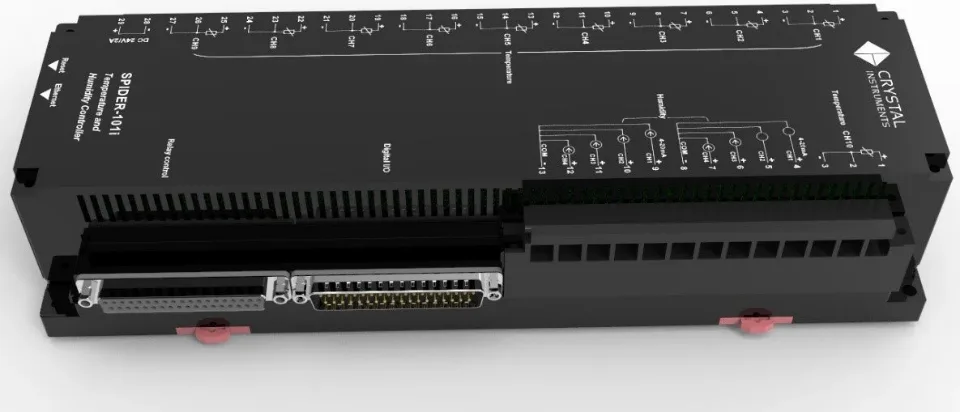
| Spider-101i | — | — | — | — |
Scroll sideways for all columns
Change the sampling rate and see how sample points describe a sine wave.
Mathematical illustration: a 5 Hz sine input. Not measured equipment data or a product performance claim. Actual selection also depends on bandwidth and anti-alias filtering.
Explore signal analyzers40 Hz sampling: approximately 8 samples per cycle.
Tell us the test object and the standard you must meet. An engineer replies within one business day.
Four voltage/IEPE inputs with six temperature and four humidity control outputs…
From MESA single-axis multi-exciter arrangements to 6-DOF eight-shaker tables…
Full random, sine and shock control for single-axis shakers, with up to 100 dB…