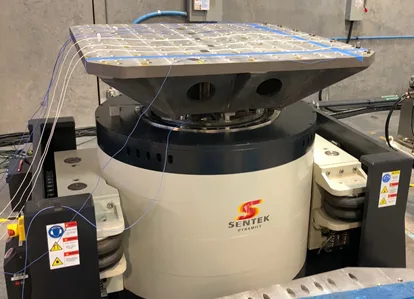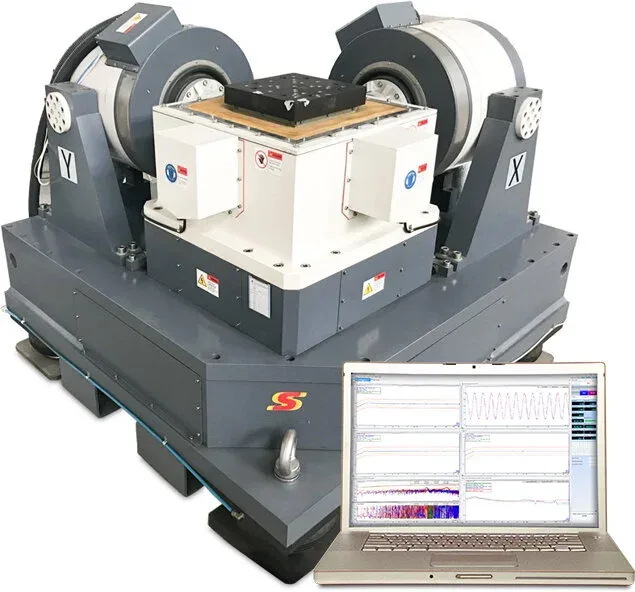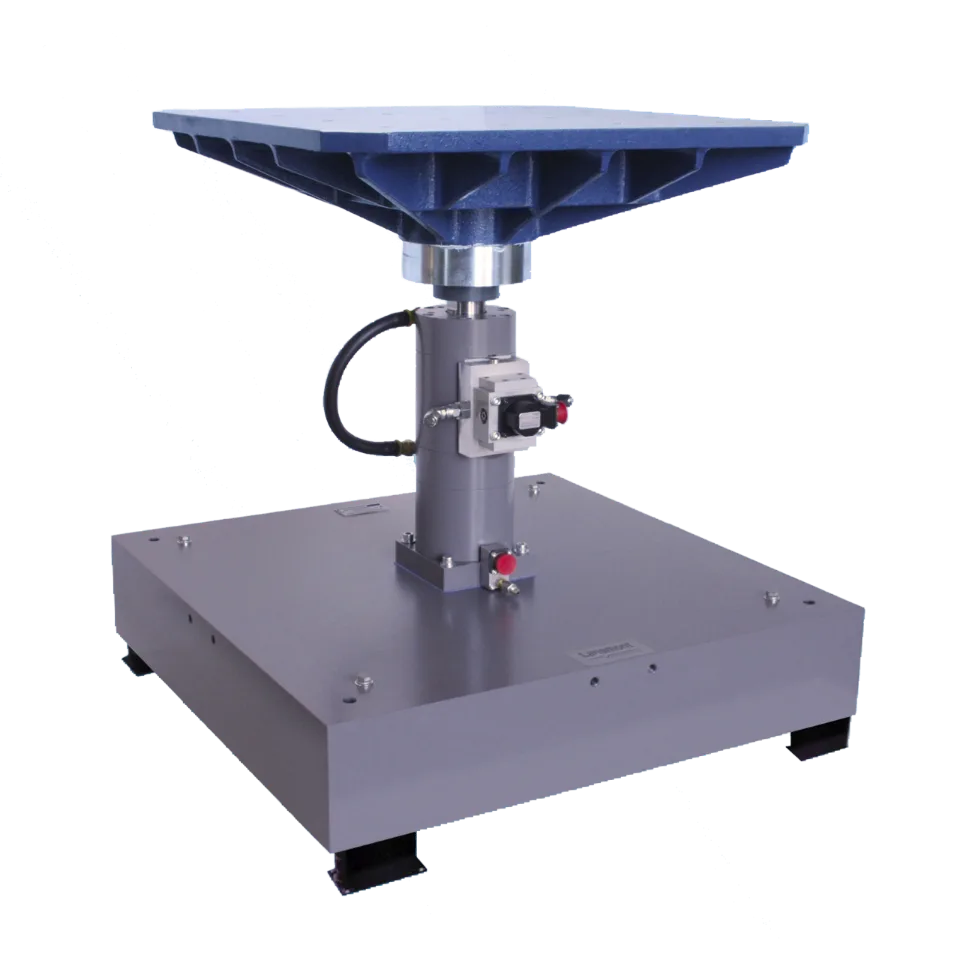

Crystal Instruments MIMO Shaker Systems
From MESA single-axis multi-exciter arrangements to 6-DOF eight-shaker tables…
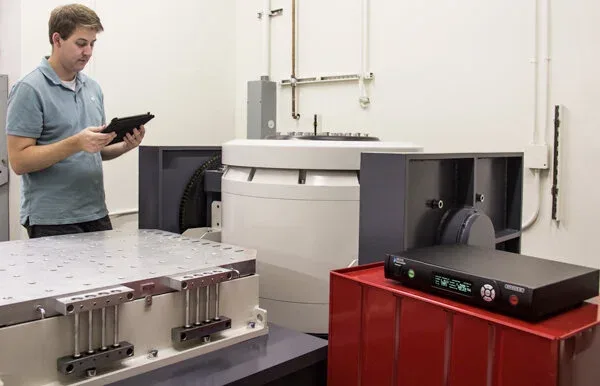
 Series overview
Full random, sine and shock control for single-axis shakers, with up to 100 dB sine control dynamic range and 512 channels for limit monitoring and recording.
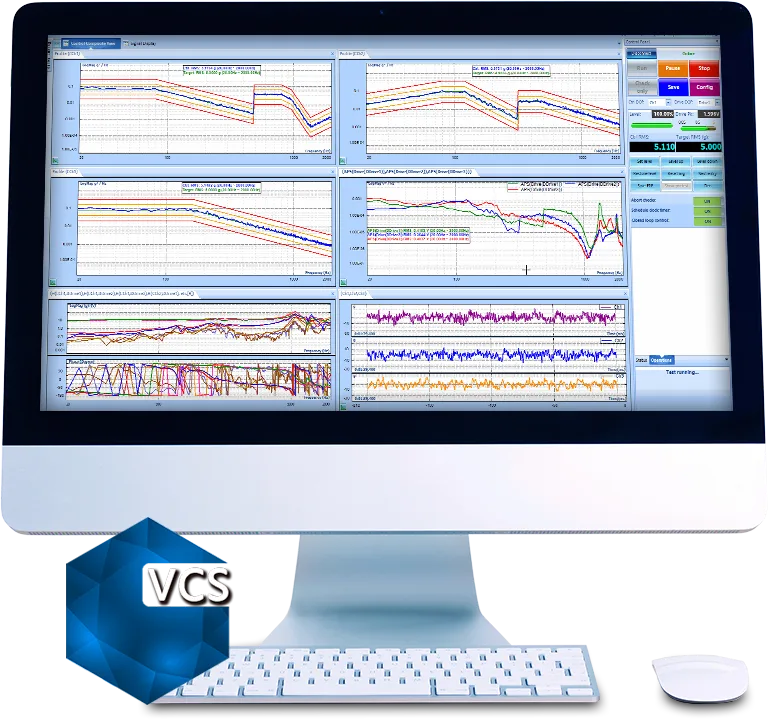
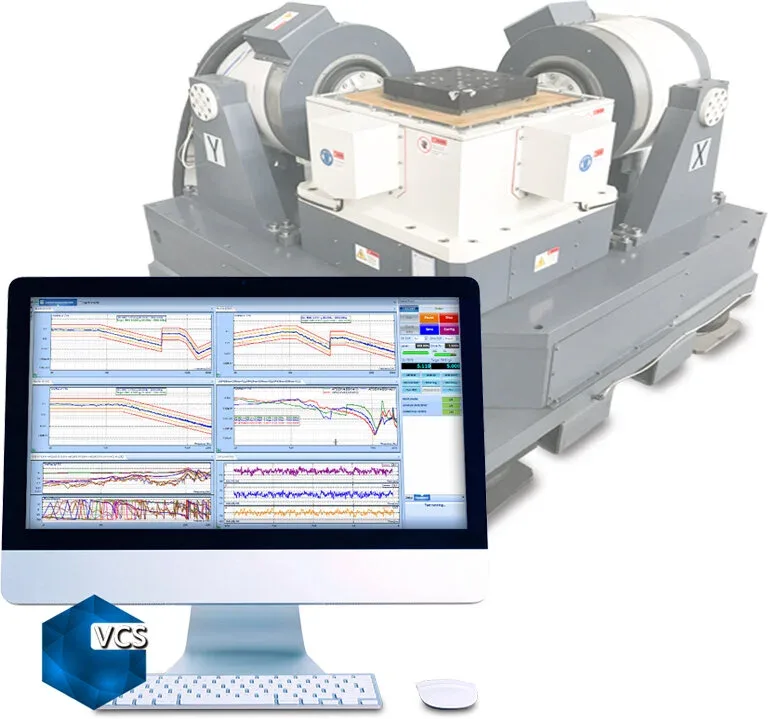
Manufacturer pageSingle-axis vibration testing delivers real-time, multi-channel closed-loop control and analysis for vertical or horizontal shakers. The system loads a target profile, drives the shaker, and continuously corrects the drive from accelerometer feedback so the control-point spectrum converges on the requested curve.
For random testing, the software shapes broadband noise with either Gaussian or non-Gaussian amplitude statistics in real time, and supports the two mixed modes Sine-on-Random and Random-on-Random, which overlay additional vibration content on the broadband random profile. Kurtosis control uses patented technology to generate a non-Gaussian time history while precisely maintaining spectrum shape; the Multi-Resolution function applies the selected resolution in the high-frequency band and eight times that resolution at low frequency, with the cutoff calculated automatically; and the Fatigue Damage Spectrum compares the potential damage of different random and swept-sine profiles to find the fastest route to a given damage level.
For sine and shock work, swept-sine control provides a spectrally pure, undistorted sine wave with up to 100 dB of control dynamic range, and as many as 512 channels can be enabled for control, notching, monitoring and time-data recording. Resonance Search and Tracked Dwell (RSTD) identifies resonances from transmissibility peaks and applies fixed, tracked or phase-tracked dwell. Multi-Sine sweeps several sine tones at once to cut test time, while Total Harmonic Distortion measurement computes THD for control and input signals. Classical shock control covers half-sine, haversine, terminal-peak and initial-peak sawtooth, triangle, rectangle and trapezoid pulses; Transient Time History control targets seismic simulation; and Transient Random control addresses gunfire or road simulation. The SRS synthesis and control module synthesizes the drive time history to match a Required Response Spectrum, and Time Waveform Replication and Acoustic Control round out the suite. Multiple Shaker Control lets one PC view and monitor up to 12 controllers.
| Model | Input channels | Dynamic range | DAC resolution | Storage |
|---|---|---|---|---|
| Spider-80M | 16 / 24 / 32 / 48 / 56 | 160 dBFS | 24 bit | — |
| Spider-81 / 81B | — | 160 dBFS | 24 bit | 4 GB flash |
| Spider-101i | — | — | — | — |
Scroll sideways for all columns
Change the sampling rate and see how sample points describe a sine wave.
Mathematical illustration: a 5 Hz sine input. Not measured equipment data or a product performance claim. Actual selection also depends on bandwidth and anti-alias filtering.
Explore signal analyzers40 Hz sampling: approximately 8 samples per cycle.
Tell us the test object and the standard you must meet. An engineer replies within one business day.
From MESA single-axis multi-exciter arrangements to 6-DOF eight-shaker tables…
Closed-loop random, sine and shock vibration testing that drives electrodynamic…
Modular multiple-axis vibration testing that scales to 512 channels, covering t…
One controller synchronizing multiple exciters across six MIMO control types: R…