


Crystal Instruments CI Data File Reader API
A free ATFX reading API — two Windows DLLs that let C#, Python, Matlab and LabV…
Real-time fractional-octave and sound level meter analysis from 1/1 to 1/12 octave, conforming to ANSI S1.11:2004 and IEC 61260-1995.
Made by Crystal Instruments Corporation. Supplied and supported in China by WTC (West Technology Corporation). · Manufacturer page ↗
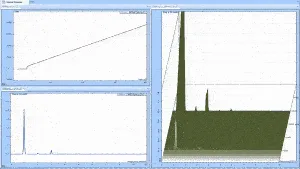
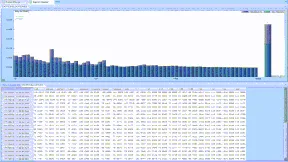
Crystal Instruments' acoustic analysis applies a bank of true real-time digital filters to the input time streams and simultaneously produces fractional-octave band signals (octave spectra) and the RMS time history of each filter band. Each filter output is essentially a 3D waterfall arranged with logarithmic frequency on the x-axis and time on the z-axis, with frequency weighting along frequency and time weighting along time. The 1/N octave analysis transforms the original analog transfer function into the digital domain via the bilinear transform; filter order and frequency ratio (binary or decimal) are user-specified, and the output is weighted or unweighted RMS, normalizable by a calibration value.
Coverage spans 1/1 to 1/12 octave: 1/1 uses 18 filters from 0.125 Hz to 16 kHz, while 1/3, 1/6 and 1/12 use 54, 107 and 213 filters respectively from 0.1 Hz to 20 kHz. The filters conform to ANSI S1.11:2004 and IEC 61260-1995, and A, B and C frequency weighting can be applied to approximate human hearing.
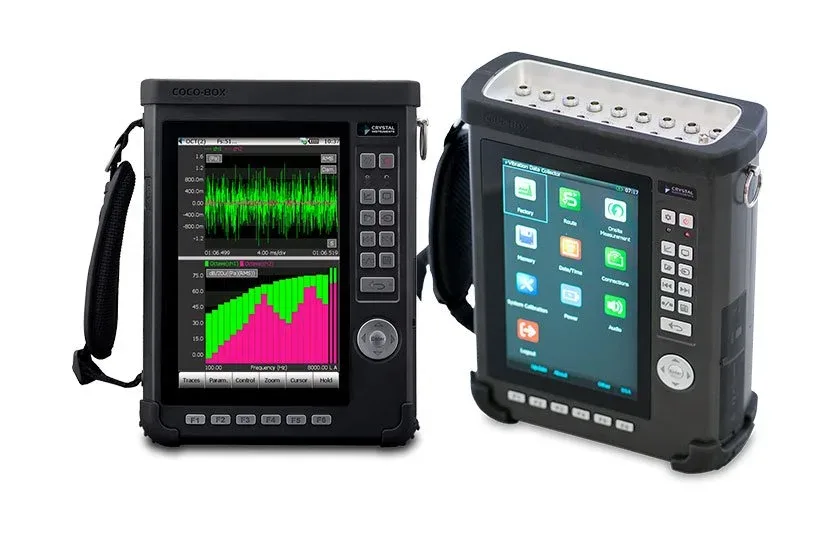
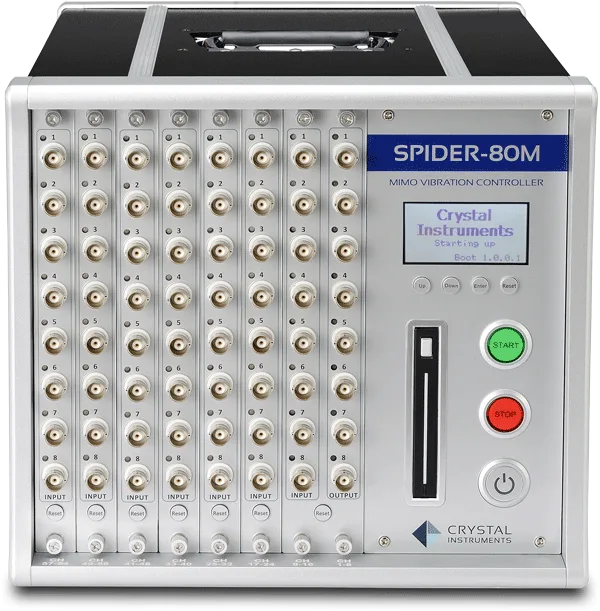
The sound level meter reports exponentially averaged values with Slow (1000 ms), Fast (125 ms), Impulse (35 ms rise, 1500 ms fall) and user-defined time constants, yielding LAF, LAFmax, LAFmin, LCpeak, Lpeak, LAeq, LAE and statistical levels such as L1, L5, L50 and L95. Sound power determination complies with ISO 3744:1994 and ISO 3745:2003, converting 1/3-octave sound pressure spectra into sound power using measurement geometry, environmental conditions and room type. The software converts octave spectra to loudness in phons and sones, and overlays Noise Criterion curves on a 63 Hz-8 kHz octave spectrum. For acoustic control, a Spider system forms a closed microphone-Spider-source loop using SISO or MIMO strategies with alarm and abort thresholds.
This entry describes a solution or service without fixed hardware specifications. Contact us for a configuration.
Tell us the test object and the standard you must meet. An engineer replies within one business day.
A free ATFX reading API — two Windows DLLs that let C#, Python, Matlab and LabV…
FIR, IIR and decimation filters running in real time on the front-end, designed…
Three FRF methods in one package: FFT, swept sine and multi-resolution spectrum…
Speed-referenced order-domain analysis with dual tachometer inputs and up to 12…
Send us the test object, the standard and your lab conditions. You get a configuration list within one business day.