

Crystal Instruments Acoustic Analysis Software
Real-time fractional-octave and sound level meter analysis from 1/1 to 1/12 oct…
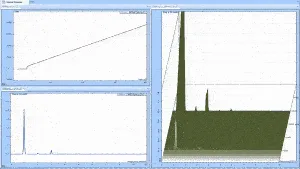
Speed-referenced order-domain analysis with dual tachometer inputs and up to 128 channels of order spectra, phased order tracks and Bode plots.
Made by Crystal Instruments Corporation. Supplied and supported in China by WTC (West Technology Corporation). · Manufacturer page ↗
Order Tracking describes a family of measurement functions for analyzing the dynamic behavior of rotating or reciprocating machinery whose speed changes over time. Unlike power-spectrum and other frequency-domain functions where the independent variable is frequency, order tracking presents data against multiples (orders) of the shaft running speed, so a harmonic or sub-harmonic component stays on the same analysis line regardless of machine speed.
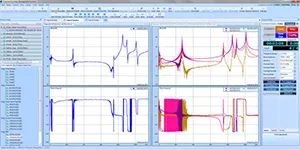
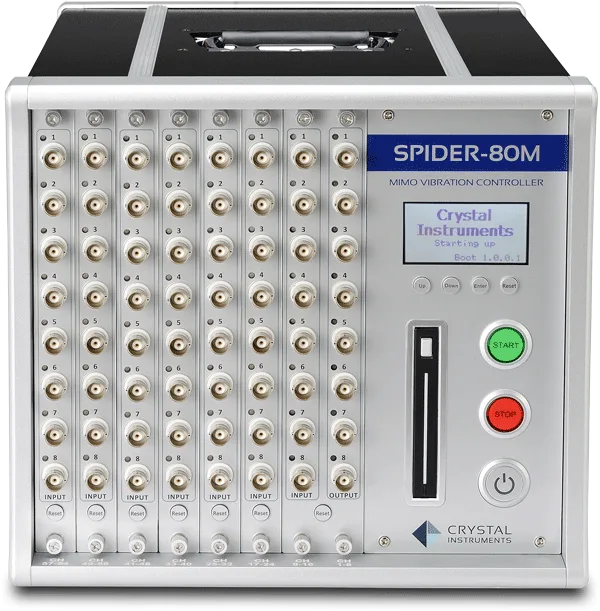
The two most useful measurements are the order spectrum, which shows amplitude versus harmonic orders of the reference shaft rotation, and the order track, the history of amplitude at a single order versus shaft RPM. Crystal Instruments' Spider processes up to two tachometer pulse inputs (analog or digital) and 1 to 8 analog dynamic response signals simultaneously, deriving high-fidelity RPM-versus-time signals from the tachometers. It can measure constant-frequency FFT spectra and order spectra for up to 128 channels, phased order tracks (including multiple and fractional orders per channel), and energy in fixed frequency bands versus RPM.
In operation the vibration signal is sampled by an ADC at a constant 102.4 kHz and protected by a fixed anti-aliasing filter. A digital reconstruction filter's output is resampled at a fixed number of points per shaft revolution, with sample times computed from successive tachometer periods assuming constant angular acceleration between pulses; the sample rate is set to k times the instantaneous speed, with k typically 2.56 to 4 samples per maximum order. The resampled angle history is transformed to the order domain by a DFT; Crystal Instruments uses a flexible algorithm allowing block sizes that are products of prime numbers (1, 2, 5) so users can pick integer resolutions and spans.
Typical uses include Run Up/Run Down surveys across an operating speed range from a few RPM to 10,000 RPM, common on automotive and aircraft engines and on commissioning of new or refurbished equipment. Phased order tracks are presented as Bode plots to characterize resonance/excitation intersections for machine diagnosis and balancing.
This entry describes a solution or service without fixed hardware specifications. Contact us for a configuration.
Tell us the test object and the standard you must meet. An engineer replies within one business day.
Real-time fractional-octave and sound level meter analysis from 1/1 to 1/12 oct…
A free ATFX reading API — two Windows DLLs that let C#, Python, Matlab and LabV…
FIR, IIR and decimation filters running in real time on the front-end, designed…
Three FRF methods in one package: FFT, swept sine and multi-resolution spectrum…
Send us the test object, the standard and your lab conditions. You get a configuration list within one business day.